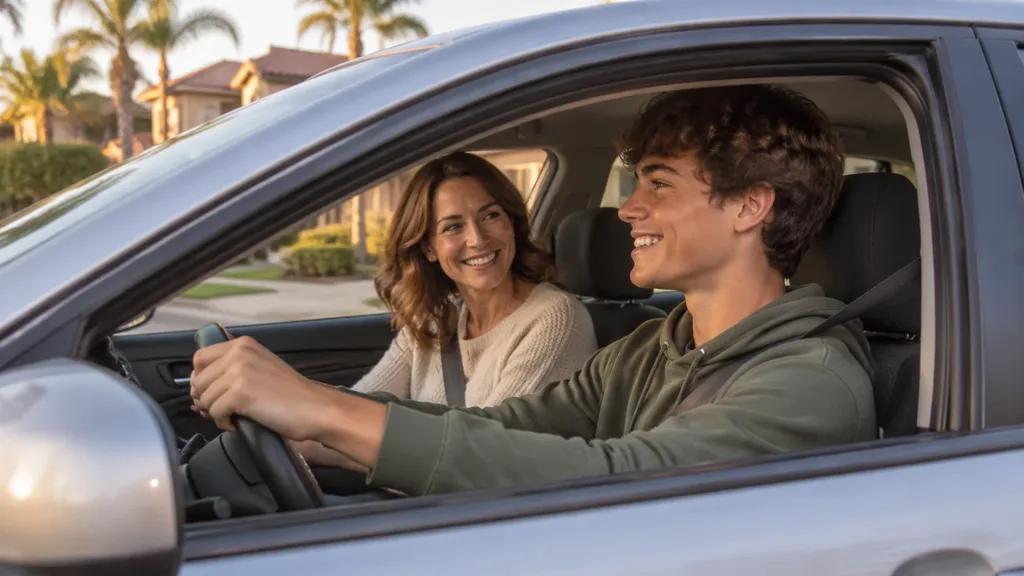
Few phone calls make parents more nervous than the one where they ask what it will cost to add their teenager to the car insurance. I have that conversation with Murrieta families all the time. The good news is that there are real ways to keep the cost reasonable without cutting the coverage that protects your family.
Here is what I walk parents through when a teen is about to start driving in California.
Key takeaways
- Call your agent when your teen gets a learner's permit, so you know exactly how your policy treats them before they drive.
- Adding a teen to your existing policy almost always costs less than a separate policy.
- In California, your driving record, miles driven, and years of driving experience drive the price the most.
- Good student and driver training discounts, plus the right car, make the biggest difference.
- Do not lower your liability limits to save money. A teen driver is when you need them most.
When to tell your insurance company
Call as soon as your teen gets a learner's permit. Carriers handle permitted drivers differently. Some extend your coverage to a permit holder driving with a licensed adult and only want them listed once they are licensed, while others want them added at the permit stage. A quick call tells you how your policy works.
Once your teen has a license, they should be on the policy. A licensed driver living in your household who is not listed can cause serious problems with a claim.
What you will need
- Your teen's permit or license number
- Which car they will drive most often
- A recent report card, if you want the good student discount
- Proof of a completed driver training course, if your carrier offers a discount for it
Why the price goes up, and what drives it in California
Teen drivers simply have more accidents than experienced drivers, and the premium reflects that. California is different from many states in how rates are set. Under Proposition 103, the biggest factors have to be your driving record, the miles you drive each year, and your years of driving experience. Insurers in California also cannot use gender to set auto rates.
That means a new driver's clean record and the number of miles they put on the car really matter.
Ways to keep the cost down
Good student discount
Most carriers offer a discount for students who keep good grades, commonly a B average or better. Ask what your carrier requires and how often they want proof.
Driver training discount
Completing a driver education and training course can earn a discount with some carriers. Keep the certificate.
Pick the right car
A sensible sedan or small SUV with good safety ratings costs much less to insure than a sports car or a new luxury vehicle. If your teen will drive an older paid-off car, you might choose to drop collision and comprehensive on that vehicle. Just be sure you could handle replacing it yourself.
Assign the teen to the right vehicle
Depending on the carrier, the teen may be rated on a specific car. Assigning them to the least expensive car to insure can help.
Telematics and safe driving programs
Many carriers have an app or device that tracks driving habits like speed, hard braking, and phone use. Safe driving can earn a discount, and the feedback helps new drivers build good habits. Ask what is available on your policy.
Bundle and review deductibles
If your home and auto are with the same carrier, you may already have a multi-policy discount. Raising your collision deductible is another option. Our post on bundling discounts has more on how that works.
Do not skimp on liability
This is the one place I push back when parents want to save. If your teen causes a serious accident, your liability coverage is what pays for the other people's injuries and damage. California's minimum limits are low compared to what a serious crash can cost, and anything above your limits can come back to you. Read more on our California auto insurance requirements post.
For many families with a new driver, I recommend higher liability limits and an umbrella policy, which adds extra liability protection above your auto and home limits for a relatively small cost.
California provisional license rules to know
Teens under 18 start with a provisional license. During the first 12 months, the California DMV generally does not allow them to drive between 11pm and 5am or to carry passengers under 20 unless a licensed driver 25 or older is in the car, with some exceptions. Following these rules also keeps your teen's record clean, which is what keeps your rate down over time.
Let's go over it together
Every family and carrier is different, so the best next step is a quick review of your current policy before your teen gets behind the wheel. We can look at your limits, which car makes sense for your teen, and which discounts you qualify for, in English or Spanish. Learn more on our auto insurance page.
Call our Murrieta office at (951) 383-3000 or contact us. We are at 26690 Madison Ave, Ste 105, Murrieta, CA 92562, Monday to Friday, 9am to 5pm.
Discounts, eligibility, and pricing vary by carrier and policy. This article is general information, not a quote.
Have a question about your coverage?
Talk to our Murrieta office in English or Spanish. We'll review what you have and explain your options.